
Interspecies
Curating spaces for human and More-than-Human encounters
How can we meaningfully convey More-than-Human perspectives within a human-curated framework?
Interspecies was a temporary exhibition displayed at the MAC/CCB museum in Lisbon from April to August 2025. Curated by Mariana Pestana in collaboration with a research team of PhD candidates interested in posthumanism and more-than-human interactions (Anna Bertmark, Fernanda Costa, Valentina Demarchi, Bernardo Gaeiras, Katerina Inglezaki, Carlos Pastor and myself), it marked the re-opening of the Architecture Centre at MAC/CCB.
Speaking of the human desire to understand, connect with, and coexist with other species, the exhibition unfolds in three stages: approaching, cohabiting, and conspiring. As materials, techniques, and modes of spatial intervention continually shape connections between places, people, and beings, architecture and design's "users" include humans, birds, plants, minerals, and others. Rather than an appreciation of nature from a distance, it proposes a sense of complicity and camaraderie from within, embracing a position of interdependence and reciprocity.

Interspecies communication. Design by Joana Lourencinho Carneiro, photographs by Fábio Cunha.
The research project was conducted in three phases. First, each researcher selected 15-20 projects where humans engaged in multispecies relationships. We intentionally kept an open mind regarding the nature of these projects to gather multiple and diverse perspectives, ranging from art, design, architecture, and interventions rooted in everyday human life, such as newspaper articles and city council reports. Some projects were global, while others were hyperlocal, enabling us to investigate multispecies encounters at different scales. Over two meetings, researchers took turns presenting and discussing their chosen projects with the group.
In the second series of meetings, researchers began drafting the exhibition narratives, exploring common emerging themes and differences across the selected projects. Early themes included concepts such as imaginaries, cohabitation & living with, governance, listening and monitoring, communication, desire to engage, and co-creation & cooperation. Throughout these meetings, themes were refined to develop the final narrative highlighting three ways humans engage with other beings: approaching, cohabiting, and conspiring.
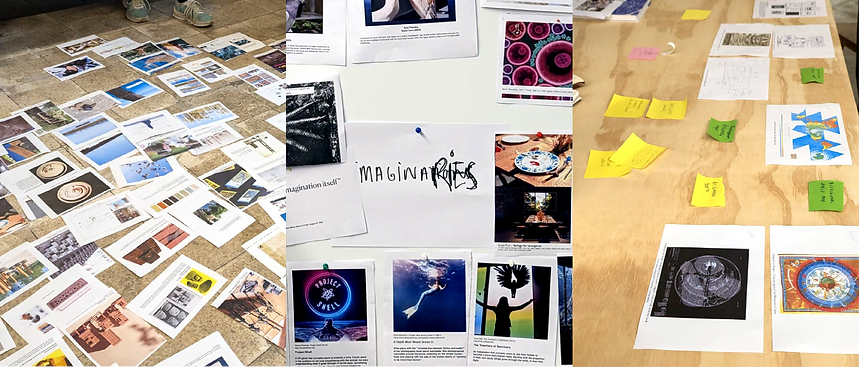
First and second meetings where the research team shared their selected projects and built the exhibition’s narrative.
In the final phase of the project, researchers gathered at the museum to explore the most effective ways to translate these narratives into a physical space. During this phase, narratives were refined and new connections between exhibition pieces were established to guide visitors on a progressive journey from the least to the most engaged level with the species. We reflected on the best approaches to represent More-than-Human voices in the museum space and to create a dialogue that engages visitors with posthuman ideas. Finally, some researchers helped to set up the space before the exhibition opened.
As a doctoral candidate interested in making posthuman knowledge accessible to broader audiences and exploring new ways to engage in multispecies relationships, being part of this research team compelled me to reflect on my own design practice, approach, and biases. I feel inspired to disseminate research findings in more accessible ways, and I am enriched from collaborating with other multidisciplinary experts who brought invaluable viewpoints and enabled deep conversations on human and More-than-Human relationships. However, while the exhibition aimed to centre interspecies subjectivity and imagination, it also prompted ethical reflection on representation, such as which species are included or excluded, and how to meaningfully convey other species' perspectives within a human-curated framework, which could be explored in the future.

Adapting the exhibition’s narrative to the museum space, building visitors’ journey, and installing the artworks.